
Why ESTEAM® is The Creative Career Bridge Your Students Need
VentureLab |
December 8, 2025

The Misconception: STEM Lacks Creativity
When students, especially young women, think of creative careers, they often picture arts fields (literature, film, fine arts). Science, Technology, Engineering, and Math (STEM) are commonly seen as rigid, mechanical, and lacking the creative spark they seek.
This is a critical misunderstanding that causes talented young people to overlook highly rewarding, innovative careers.
- Reality: The world’s most significant challenges—from climate change to healthcare—demand creative technology solutions and innovative engineering.
- The Loss: As education innovator Sir Ken Robinson noted, many brilliant, creative people believe they are not, because what they were good at in school wasn’t valued.
The ESTEAM® Solution: Bridging Disciplines
ESTEAM (Entrepreneurship, Science, Technology, Engineering, Arts, and Mathematics) serves as the ultimate Creative Career Bridge. It smoothly transitions students from abstract, siloed learning to practical, integrated work applications.
1. Focus on Creativity and Innovation (The “A” and “E”)
The foundation of this bridge is creativity, a trait often undervalued in traditional STEM education:
- “A” – Arts: Brings skills like design thinking, visual communication, critical observation, and imaginative problem-solving—essential for user-friendly products and impactful branding.
- “E” – Entrepreneurship: The driver that converts a creative idea into a valuable solution. It teaches students to innovate, take calculated risks, and create value—crucial skills for starting a business or leading an initiative.
2. Integration of Hard and Soft Skills
The ESTEAM model ensures students are career-ready, not just technically proficient:
- Hard Skills (STEM): Provides the technical knowledge (coding, engineering principles, data analysis) necessary for high-growth industries.
- Soft Skills (E & A): Develops essential professional competencies:
- Communication: Pitching ideas and writing proposals.
- Collaboration: Working in diverse, interdisciplinary teams.
- Resilience: Learning from failures (a core component of the entrepreneurial mindset).
3. Connection to Future Careers
ESTEAM directly addresses the needs of the modern, interdisciplinary job market:
- Interdisciplinary Demand: Today’s most sought-after roles—from UI/UX designers and data visualization experts to product managers—require a fusion of technical expertise (STEM), creative problem-solving (Arts), and business acumen (Entrepreneurship).
In short, ESTEAM ensures that students not only have the tools (STEM knowledge) but also the vision and initiative (Arts and Entrepreneurship) to build their own successful careers.
“You can be creative in anything—in math, science, engineering, philosophy—as much as you can in music or in painting or in dance.” -Sir Ken Robinson
Entrepreneurship: The Innovation Accelerator
Entrepreneurship education is the powerful engine that accelerates creativity within the ESTEAM model.
| Problem | Solution |
| Traditional Education: Focuses on test “outputs” and strict rules, often discouraging risk. | “E”-Skills: Introduces new possibilities for teaching skills that stimulate curiosity and creativity. |
| The Myth of Perfection: Ideas are expected to come out “full-blown and perfect.” | Reality of Innovation: Entrepreneurship immerses students in messy, creative problem-solving. |
| Siloed Skills: Solutions are taught in isolation (e.g., Science class vs. Art class). | Integrated Solutions: Students are challenged to create solutions that span multiple disciplines. |
It’s difficult to name a major global challenge today—energy, health, communication—where a practical solution doesn’t involve the creative application of technology, engineering, and science.
🌟 Ignite Innovation with ESTEAM® Design Kits
Looking for a practical, hands-on way to make the creative power of ESTEAM tangible for your students?
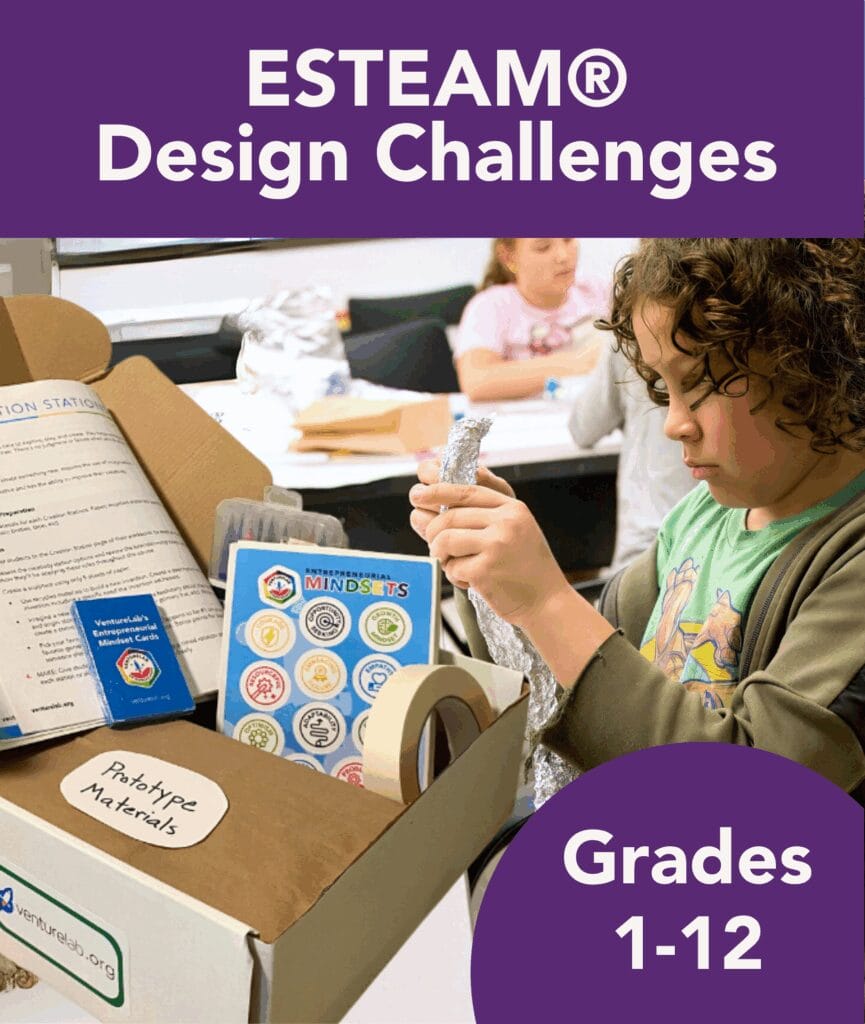
ESTEAM® Design Challenge Kits transform learning into an adventure. They guide students step-by-step through:
- Mindset exploration
- Hands-on prototyping
- Creative problem-solving
- Meaningful reflection
Students actively brainstorm, prototype, and iterate on real-world challenges, developing valuable mindsets and skills for future success.
The outdated notion that STEM is purely mechanical and separate from creative pursuits is a hurdle we must overcome. ESTEAM® doesn’t just add a few letters to an acronym; it reframes education, validating that true innovation requires the boldness of entrepreneurship and the vision of the arts.
By adopting the ESTEAM® framework, educators are doing more than just teaching subjects—they are giving students the integrated skills, confidence, and creative license to become the problem-solvers, innovators, and future founders who will shape tomorrow’s world.